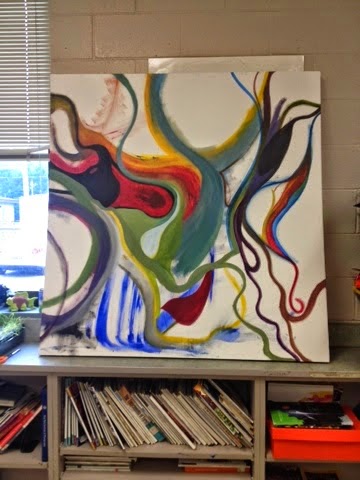
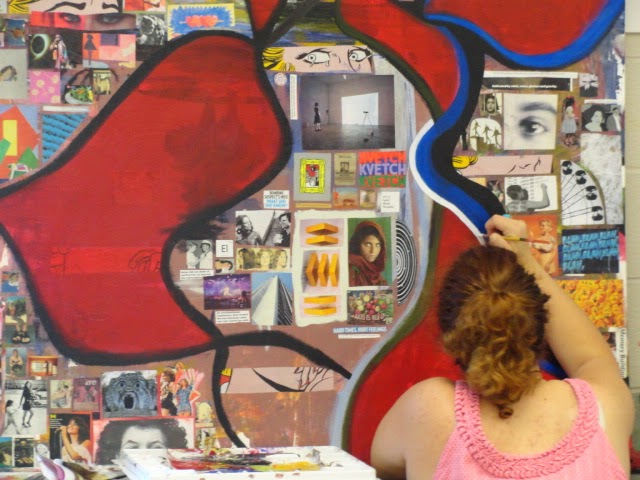
A few weeks ago, we announced that the crack team of art educators here at Apex have been working on what we are calling "not your momma's art teacher's units".
Each unit we are developing is based, not solely on making art but on being an artist. We took a long look at what artist do, created a list of possible artist behaviors, and scrubbed the list down to our top seven.
These include Artists Observe, Artists Steal, Artists Communicate, Artists Collaborate, Artists Curate and Artists Solve Problems. A sneak peek of what these units might entail are now available through the Portal!
Pretty exciting stuff!
.
Pages
Ian Sands has taken a new position at South Brunswick HS Check out it out! http://ArtofSouthB.com
Monday, July 28, 2014
Thursday, July 24, 2014
NCMA Teen Inspired Think Tank
Kimberly Sudkamp and Michelle Harrell present collected notes to the group
Melissa Purtee, Kimberly Sudkamp, and Ian Sands spent the last two days taking part in a think tank with the quest of re-imagine the NCMA's Teens Inspired program.
The think tank encapsulated two ideas. First, brainstorming ways to transform the Teens Inspired exhibit into a more student centered approach. Second, developing ideas for connecting two schools using the NC Museum of Art as a hub.
The future of the program looks exciting as it continues to develop a professional learning community of educators set on exploring a flipped museum experience through student directed initiatives.
Melissa Purtee explains her group's proposal
You can be sure Apex will continue to be involved not only with continued teacher planning but student engagement in many of the upcoming activities.
Saturday, July 19, 2014
Making Artists...
by ian sands
Dorothy: Oh, will you help me? Can you help me?
Glinda: You don't need to be helped any longer. You've always had the power to go back to Kansas.
Dorothy: I have?
Scarecrow: Then why didn't you tell her before?
Glinda: She wouldn't have believed me. She had to learn it for herself.
Scarecrow: What have you learned, Dorothy?
Dorothy: Well, I—I think that it, that it wasn't enough just to want to see Uncle Henry and Auntie Em — and it's that — if I ever go looking for my heart's desire again, I won't look any further than my own backyard. Because if it isn't there, I never really lost it to begin with! Is that right?
Glinda: That's all it is!
Scarecrow: But that's so easy! I should've thought of it for you -
Tin Man: I should have felt it in my heart -
Glinda: No, she had to find it out for herself.
I've learned a lot over the last year and it has changed my personal philosophy about teaching art. My old motto was "make art". Now, I'm not so much interested in having students make art but rather making artists. This was a big paradigm shift. It removed the focus from the product and placed the emphasis on the person and the process.
Ariel was a student in my class last semester. She was consistently exploring geometric vs organic shapes through a series of small, acrylic paintings. As her teacher, I wanted to see her push past these exercises. I could have assign her a project but that would have been my solution. Instead, I gave her the materials and instructions for building a 4' x 4 ' canvas.
The newly gessoed canvas outside on the picnic table
Ariel took a few days staring at the canvas. I joked with her that she was afraid of it. To some extent I was right but soon Ariel started painting her organic shapes.
The painting during week one
A few days into the painting, Ariel (in her words) was having a bad day. She took a palette knife and covered the canvas in muddy brown.
The mud after a bad day
The painted remained in this state with Ariel not picking up a paint brush for several days. It was now mid May and I was starting to second guess my teaching. If I had just given her a project, she would already have a successful, completed product.
Then, Ariel changed course. She started cutting out magazine images in geometric shapes and glueing them to the canvas. Next, she applied thick, black organic lines in paint.
Starting over
Ariel was onto something. Throughout the month and into June, Ariel continued to work on her art. By the end of the school year she had almost completed a well balanced composition that incorporated both geometric and organic characteristics.
Ariel was thrilled with her results as was I. She had spent many weeks not simply painting, but contemplating, struggling, engaging others in conversation and eventually, following her own voice.
Ariel with her painting in June
Any opponent could easily argue against my teaching philosophy. It could be pointed out that Ariel wasted two months on this project. She could have completed at least four teacher-directed projects in the same time. Teacher-lead projects could have also incorporated more concepts with less ambiguity.
If my focus was still on making art, I would agree. However, I believe the process that Ariel went through held the most value. It was something I couldn't tell her.
Scarecrow: But that's so easy! I should've thought of it for you -
Tin Man: I should have felt it in my heart -
Glinda: No, she had to find it out for herself.
...
..
.
...
..
.
Sunday, July 13, 2014
It's Summer! The Art Teachers Must Be Sitting by the Pool, Right?
Actually, the Apex Art Teachers and friends have a busy two weeks ahead of them. Here are a few of the items on our agenda...
AOE Conference Summer 2014
Thursday, July 17th
Ian Sands will be presenting "Beyond Collaboration - Connecting Sister Schools" Imagine if two schools decided to work together in a true exchange of ideas, over an extended period of time, with open dialogue and communication.In this presentation you will learn everything needed to partner with a Sister School. You will gain proven project ideas, explore the best methods of communication, and learn which technology can be used to ensure a successful Sister School collaboration.

TAB/ Mass College of Art and Design Summer Institute
Wednesday, July 18th
Speaking of Sister Schools, Colleen Rose will join Ian Sands as they share their experiences teaching their style of choice based art education with fellow high school art teachers. This workshop is part of week long course and is the only course exclusively offered by the founders of Teaching for Artistic Behavior. This course is available for graduate credit.
NCMA Teen Inspired Thinktank
Wednesday and Thursday July 23-24
Melissa Purtee, Kimberly Sudkamp, and Ian Sands will take part in a thinktank of educators who will re-imagine the NCMA's Teens Inspired exhibition and plan an online resource for students. Participants will brainstorming how to transform Teens Inspired to a more student centered approach.
Right along with all these exciting activities, we've still been very busy planning our new units.. and these aren't your momma's art teacher's units! Each unit we are developing is based, not solely on making art but on being an artist. We took a long look at what artist do, created a list of possible artist behaviors, and scrubbed the list down to our top seven. Take a look, click here!
Thursday, July 17th
Ian Sands will be presenting "Beyond Collaboration - Connecting Sister Schools" Imagine if two schools decided to work together in a true exchange of ideas, over an extended period of time, with open dialogue and communication.In this presentation you will learn everything needed to partner with a Sister School. You will gain proven project ideas, explore the best methods of communication, and learn which technology can be used to ensure a successful Sister School collaboration.

TAB/ Mass College of Art and Design Summer Institute
Wednesday, July 18th
Speaking of Sister Schools, Colleen Rose will join Ian Sands as they share their experiences teaching their style of choice based art education with fellow high school art teachers. This workshop is part of week long course and is the only course exclusively offered by the founders of Teaching for Artistic Behavior. This course is available for graduate credit.
NCMA Teen Inspired Thinktank
Wednesday and Thursday July 23-24
Melissa Purtee, Kimberly Sudkamp, and Ian Sands will take part in a thinktank of educators who will re-imagine the NCMA's Teens Inspired exhibition and plan an online resource for students. Participants will brainstorming how to transform Teens Inspired to a more student centered approach.
Right along with all these exciting activities, we've still been very busy planning our new units.. and these aren't your momma's art teacher's units! Each unit we are developing is based, not solely on making art but on being an artist. We took a long look at what artist do, created a list of possible artist behaviors, and scrubbed the list down to our top seven. Take a look, click here!
Friday, July 4, 2014
Transitioning from Modify Choice to Full TAB
We received an email asking how we used themes and concepts together and how we presented these ideas to the class. In this post, we'll respond to that email by outlining how we transitioned from Modified Choice to full TAB using our Art Two class as an example.
Last summer we made a chart with three different categories: Themes, Concepts and Media. It was a big list of all the things we thought we might want to cover. Here is a look at each:
Themes: some of our themes were more conceptual (I.e identity) and some were less ( I.e up close and personal). The less conceptual ones are easier to solve so are better for students who haven't had as much experience coming up with ideas. In either case, we prefer themes that allow for more than one solution as opposed to using a noun as a theme. For example, "Animals" makes a poor theme because the students will simply print out a photo of a turtle or puppy.
Theme Examples:
Up close and personal, sticky situation, culture, identity, play, systems, empathy, boundaries, transformation , absence
-------
Concepts: This was basically a list of principles we wanted the students to be familiar with. With Art Two, we wanted to focus on the principles of design.
Concept Examples:
Contrast, repetition, exaggeration, juxtaposition, emphasis, movement, interactivity, appropriation, collaboration
-------
Media: When we created our media list, we put a focus on what materials we wanted to introduce. We also grouped them when it seemed beneficial. In a TAB situation, you want to make sure the students have an introduction to the material. If for no other reason than to make sure they know how to retrieve, properly use, clean up and put away the supplies. Grouping the media is also beneficial when teaching mini lessons. I.e you can teach cross-hatching with pencil and with pen & ink.
Media Group Examples:
Black and white: pen and ink, charcoal, pencil.
Color 1: oil pastel, chalk pastel, color pencil.
Color 2: acrylic paint, water color paint, spray paint.
3D: clay, paper mâché, plaster strips.
The final step was to select which themes, concepts and media to group together. We did our best to determine which theme would match up with which concept and what order to introduce media.
The earlier projects had less choice. As the class progressed, everything opened up. Here are examples of a few of our Art Two projects in order:
Project 1:
Theme: What's the Point
Concept: Contrast
Media: Pen & ink, charcoal or pencil
See more student solutions here:
Project Two:
Theme: Up close and personal
Concept: Emphasis
Media: oil pastel, chalk pastel, color pencil
( you will notice in this project some students were already breaking out of the box using water color and even make up
See more student solutions here:
Project 3:
Theme: Sticky situation
Concept: Repetition
Media: Paint (any)
See more student solutions here:
Project 4:
Theme: Portrait
Media: non traditional material
(the point of this project was to let the students realize they could break out of any box)
See more student solutions here:
So how did the students react to this method of teaching?
You can read their responses here:
Saturday, June 28, 2014
The Most Influential DUDES in Art Ed
According to The Art of Education online magazine, Mr Sands (that's me) is considered one of the most influential Dudes in Art Education! Well, that's not too shabby a title!
I'm also in good company as other teachers named include Andrew McCormick, Ted Edinger (AKA Mr. E) and Craig Roland to name a few.
You can read about these and the other top dudes in education right here!
But you know, behind every man is a great woman.. or in my case, three! I wouldn't be half as influential without the spectacular work of all the art teachers at Apex. Ms Sudkamp, Ms Purtee and Ms Rossi.
Thanks Alecia Eggers and AOE for including me on this prestigious list!
Sunday, June 22, 2014
Not Your Momma's Art Teacher's Units
While everyone is lounging by the pool soaking up the rays, the crack team of educators back at Apex Art headquarters are diligently constructing an amazing program for next fall. Elaborate flow charts are scrawled across the whiteboard as hot topic ideas spur fervent debate.
Previously, such encounters have produced art-shattering changes such as Student Choice, Theme-Based projects and the Portal. Of course, we will continue to incorporate all of these concepts as we move forward. So what's so amazing that it's the focus for next year's curriculum? Units!
Ok, units might not sound so spine-tingling. However, these aren't your momma's art teacher's units. Each unit we are developing is based, not solely on making art but on being an artist. We took a long look at what artist do, created a list of possible artist behaviors, and scrubbed the list down to our top seven.
Artists Observe:
This unit will cover observational drawing and possibly painting. It will incorporate still life drawings and nature drawings as well as architectural drawings, urban sketching or even plein air painting.
Artists Steal:
Discussions will revolve around artists such as Roy Lichtenstein, Shepard Fairey, Damien Hirst. Themes could be based on concepts such as appropriation and Intertextuality.
Artists Communicate:
This unit will cover the many ways art is used to communicate ideas and thoughts. It could cover a range of art works from contemporary artists to commercial fields such as advertising and illustration to video and animation. This could culminate with a theme based project.
Artists Collaborate:
This unit will introduce the concept of working together to build something bigger than the sum of its parts. Consider discussing and contrasting different ways artists collaborate from Jeff Koons who hires people to create his art to teams like Christo and Jeanne-Claude who worked together.
Artists Curate:
This unit will cover how museum and gallery exhibits are conceived and put together. It could cover everything from artist styles and collections to how museum curators pick topics for shows. Could look at different artists and explore what about their work gives it a style. Could culminate with each student producing three works with their own unique style.
Artists Solve Problems:
This unit will deal with limitations and constraints artist apply to themselves style wise, material wise and concept wise. It could also speak to limitations artist overcome from Matisse or Close in a wheel chair to Phil Hansen's embrace the shake. Could also discuss overcoming environmental constraints like Michelangelo painting the ceiling. Projects could range from limiting student materials, to working in difficult situations.
Artists are Self Learners:
This unit will encourage students to use tutorials, create tutorials themselves, and explore new materials. Sharing what they learn with students in their class or even other classes could also be incorporated.
So go ahead, relax, enjoy your summer knowing we've got it all under control.
Wednesday, June 18, 2014
I Don’t Like Grading, And I Don’t Think I’m Gonna Do That Anymore
Over the last year, we implemented many changes at the Art of Apex. Everything from new technologies like our student blogs and portal site to curriculum changes like theme based teaching and TAB/student choice. The one area I (Ian Sands) personally have struggled with is grading.
Read the Entire Post:
I Don’t Like Grading, And, Uh, I Don’t Think I’m Gonna Grade Anymore
I recently wrote an article about this for The Art of Education. Please click here to read the article and feel free to post any comments you might have at the bottom of the post.
Next year I'm considering not grading their projects or their blogs at all, but simply tracking student's work. Our grading software allows us to mark projects as "complete" or "missing" where grades go. When it's time to enter grades, I'll sit down with each student with a copy of this spreadsheet and have a conversation about what grade they think they have earned in my class for that period of time. Instead of grading project, or grading blogs, I'll simply give them a grade for the class.
Friday, June 13, 2014
2014 Reflections: Part Two - Favorite Medium
Which medium did you most enjoy working with and why?
This semester the medium I enjoyed working with the most was oil pastels. Although they can make your hands pretty dirty I enjoyed working with it because of the many techniques it allows. For example in the Space-theme project I used oil pastels.For the planet on which the aliens are standing, I used the scumbling technique, and by applying it many layers, it gave the planet a unique texture and let it seem more realistic. For the Saturn planet I used techniques like burnishing and added highlights to make it seem like the light from the spaceship was falling upon it.
For the 2 in 1 project I also used oil pastels which stood out and contrasted well with the black and white text background. I liked how oil pastels burnish when you apply it in layers to create a vibrant color and unique texture. Using this technique I colored the flamingoes with peach red yellow and white oil pastels.it burnished well and the flamingoes had a natural color.
Overall I like how vibrant oil pastels can be on paper because it helps produce a contrast in your artwork. I like how if you make a mistake, you can simply add more layers of oil pastel to cover it up.I also enjoyed exploring highlights,core shadows and cast shadows in one of our warmups with oil pastels.
~Anam
I enjoyed working with the cardboard during this semester. Working with the cardboard allowed me to make one of my favorite pieces that I made during this class. Cardboard is a very interesting media to work with, because mistakes cannot be reverted, and you only have one way to change the way it looks.
Due to how simplistic cardboard is, it makes it look very easy to reach your vision for the artwork. I was only able to create one piece with this media, (shown above) which I feel turned out very well.
~Chris
-----
This semester the medium I enjoyed working with the most was oil pastels. Although they can make your hands pretty dirty I enjoyed working with it because of the many techniques it allows. For example in the Space-theme project I used oil pastels.For the planet on which the aliens are standing, I used the scumbling technique, and by applying it many layers, it gave the planet a unique texture and let it seem more realistic. For the Saturn planet I used techniques like burnishing and added highlights to make it seem like the light from the spaceship was falling upon it.
Overall I like how vibrant oil pastels can be on paper because it helps produce a contrast in your artwork. I like how if you make a mistake, you can simply add more layers of oil pastel to cover it up.I also enjoyed exploring highlights,core shadows and cast shadows in one of our warmups with oil pastels.
~Anam
------
Fire!! Thats all I really have to say. It was the most risky medium I have worked with. My portfolio is basically, acrylic, pencil, acrylic, acrylic, FIRE!
I really did not think my plan would work, which it did fail the first attempt but second time was exactly how I imagined it would look- actually better. It was great for lighting and gaining the audience's attention. It gave a great feel to my piece, just how I people feel excited during a circus performance.
During the D.C trip in the gift shop of the contemporary art museum, there was a book called Food Art. I just flipped through the pages thinking- How did I not think of that?! Food Art is brilliant, and the possibilities are infinite. There was just bananas suspended in the air and a light above them so on the floor was a shadow of a monkey (haha I am the banana girl). Absolutely genius!
~Michelle
-----
My favorite medium by far is colored pencil because it allows me to draw with precision while I am still able to mix colors and blend like when using paint. Also, at the end of the year, I made a colored pencil piece with white pencils on black paper which I really enjoyed because I had to emphasize the light values rather than the dark values on a normal colored pencil piece.
My biggest regret about this semester is limiting myself to colored pencil as medium. I wish I would have explored new mediums because I may have found a new favorite one. A few mediums I would have like to tried are watercolor, stenciling, and mixed-media/collage.
~Anna
-----
I really did not think my plan would work, which it did fail the first attempt but second time was exactly how I imagined it would look- actually better. It was great for lighting and gaining the audience's attention. It gave a great feel to my piece, just how I people feel excited during a circus performance.
During the D.C trip in the gift shop of the contemporary art museum, there was a book called Food Art. I just flipped through the pages thinking- How did I not think of that?! Food Art is brilliant, and the possibilities are infinite. There was just bananas suspended in the air and a light above them so on the floor was a shadow of a monkey (haha I am the banana girl). Absolutely genius!
~Michelle
-----
My favorite medium by far is colored pencil because it allows me to draw with precision while I am still able to mix colors and blend like when using paint. Also, at the end of the year, I made a colored pencil piece with white pencils on black paper which I really enjoyed because I had to emphasize the light values rather than the dark values on a normal colored pencil piece.My biggest regret about this semester is limiting myself to colored pencil as medium. I wish I would have explored new mediums because I may have found a new favorite one. A few mediums I would have like to tried are watercolor, stenciling, and mixed-media/collage.
~Anna
-----
I enjoyed working with the cardboard during this semester. Working with the cardboard allowed me to make one of my favorite pieces that I made during this class. Cardboard is a very interesting media to work with, because mistakes cannot be reverted, and you only have one way to change the way it looks.
Due to how simplistic cardboard is, it makes it look very easy to reach your vision for the artwork. I was only able to create one piece with this media, (shown above) which I feel turned out very well.
~Chris
-----
Over the course of the year I got to work with a lot of different medium that I either haven't worked with in a long time or at all. My favorite medium that I got to work with this year was the duct tape.
During the perspective project our group decided to work with duct tape as our medium. It was a lot of fun I've never thought about completing a project with duct tape before. That was probably my favorite because it was something new and different to work with and it was a group project so I got the chance to do it with a bunch of my friends.
Subscribe to:
Posts (Atom)